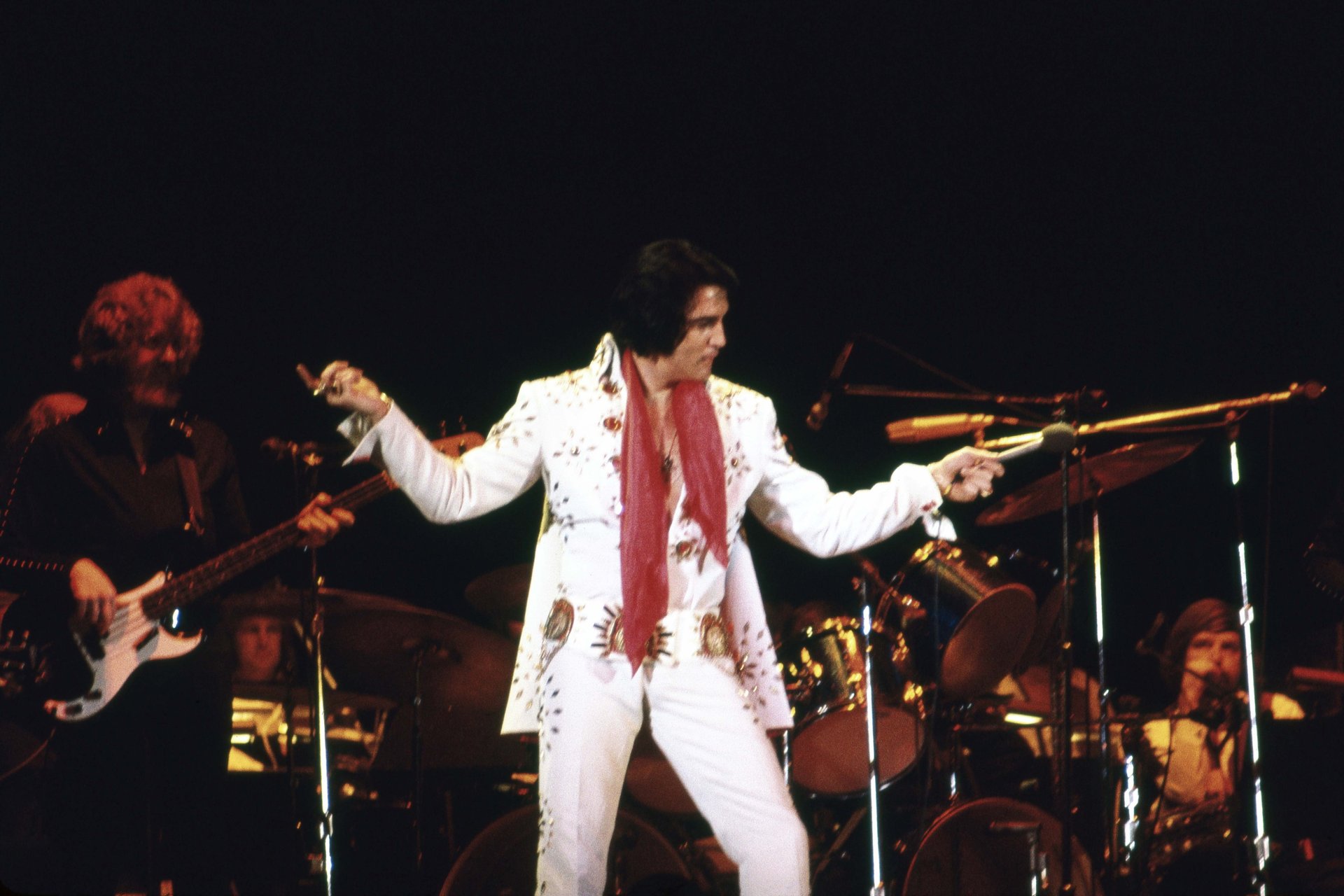
RCA Unearths 100 "Lost" Elvis Recordings
RCA Unearths 100 "Lost" Elvis Recordings, Just in Time to Celebrate His Death Date
By Robert Wilonsky
Twenty-five years after he died, Elvis Presley is once again at the top of the pops. He's
dead, right? Dead 25 years come August 16, Elvis Presley is, once more, the hottest corpse
in the ground. Just a few days ago, he topped the pops in the United Kingdom for the first
time since he died on the dumper - with a song, no less, that was relatively unknown to all
but the hardcore till its use in Ocean's Eleven last year and a new Nike ad tied to the
World Cup. Now, the Mac Davis-Billy Strange-penned "A Little Less Conversation" is about to
become the ubiquitous single of the summer of 2002, thanks to a groovy redo by Junkie XL
that polishes an already sparkling song, the funkiest thing Elvis cut in the 1960s. Released
first as a single in 1968, when the song appeared in Live a Little Love a Little, the
remix hits U.S. outlets this week, only days after Presley bumped the Beatles from the
history books. Where both were tied at the top, with 17 U.K. number ones, now Elvis walks
alone.
The Elvis-JXL single, which marks the first time Elvis Presley Enterprises has allowed
such a remix, is but the beginning of an Elvis onslaught. In coming weeks, majors and
minors will begin revving up the money machine to capitalize on - pardon, celebrate- -
the anniversary of the King's dethroning. Tomato Records, which has been plundering
Townes Van Zandt's tomb in recent weeks, has slated for release Elvis' recordings from
the Louisiana Hayride in the mid-'50s, which have been circulating in legit and illegit
forms for years. And RCA's got two monster releases forthcoming, chief among them
September 24's ELV1S 30 #1 Hits, which parent company BMG insists is the "first ever
collection of 30 Presley number-one singles on one CD."
But the most significant release tied to the anniversary of Presley's death is Today,
Tomorrow & Forever, a four-disc boxed set containing 100 previously unreleased Elvis
tracks, a fairly astonishing claim given that Elvis allowed the release of alternate
tracks during the '70s, when he needed to fill space on albums to which he'd committed.
(At one point, he was under contract to RCA for three albums a year, a burden he'd become
too weary to bear.) And only five years ago, RCA released Platinum: A Life in Music,
which proffered Presley's chronological history in the studio using 77 outtakes among its
100 tracks. Besides, it's not as though even the casual fan is unfamiliar with the bulk
of what appears in this collection; here, for the 432nd time, are "Heartbreak Hotel" and
"Hound Dog" and "In the Ghetto" and "Are You Lonesome Tonight?" and on and on. There's
even some real crap here, an admission made plain in Colin Escott's track-by-track liner
notes: "Elvis had good reason to sleepwalk through 'The Love Machine.' It was, by any
yardstick, a ghastly song."
Yet Today, Tomorrow & Yesterday is one of those compelling listens, a best-of-and-rest-of
that offers an alternate history, a what-if? time line. It begins with a July 1954
recording of "Harbor Lights" (a hit for Bing Crosby only four years earlier), cut during
Elvis' very first days in the Sun studios, and it ends with a February 1976 rendition of
"Hurt," which had been a concert staple and, Elvis used to insist, one of his favorite
songs. In between are legendary live recordings from shows seen on old footage but never
heard (specifically, the May 16, 1956, performance at the Robinson Memorial Auditorium in
Little Rock), outtakes from movie soundtracks (including the collection's title song, a
long-lost duet with Ann-Margret originally recorded for Viva Las Vegas) and copious
alternate takes from sessions made at home and in the studio. Throughout, Elvis can be
heard cracking jokes (including one about the Vietcong at the height of the Vietnam War),
making small talk with the band and trying to figure out just how the hell to give depth
to the fluff he was stuck with throughout the latter part of his career.
"This is an intimate way of getting to know Elvis," says Ernst Jorgensen, calling from his
garden in Denmark. Jorgensen has been handling RCA's Elvis reissues for years, and the
Great Dane has become a beloved figure amongst Elvis devotees, second only to biographer
Peter Guralnick. "I am a foreigner, so I look at Elvis with an element of surprise. In
America, Elvis was ridiculed, a victim of the way he died and looked, the abuse of
medicine, all that. In a small country like this, we would have been much kinder to him.
When we started in the early '90s, it was like nothing of Elvis' music was left. I was
trying to get people back to where he came from. The music is where the real greatness
is, and we wanted to tell that story."
Alex Miller, head of BMG's reissue department, says the 100 tracks were collected from
myriad disparate sources--from collectors (the label gets at least one call a day from
someone claiming to have a long-lost tape), from the label's estimable vaults, from
engineers who worked on sessions, from radio stations that broadcast Elvis concerts in
the '50s. Jorgensen and Roger Semon began compiling the box five years ago - around the
time the 300,000-selling Platinum was released - in preparation for the 25th anniversary
of his death. Theirs would be a revisionist history of sorts: They wanted the world to
hear "In the Ghetto," for instance, stripped of its garish ornamentation; they wanted to
show the playful Elvis, the thoughtful Elvis, the goofy Elvis, the disinterested
Elvis. It would be a chronological story, much as Platinum, but without the reverence
that collection showed. Today, Tomorrow & Yesterday is almost a blasphemous box; it's
like a fête to which the guest of honor shows up a little out of it and makes one hell of
a mess. But since Elvis often had little regard for his own legacy - some 12 years after
Elvis stepped into the Sun, he wound up recording "Yoga Is as Yoga Does" - why shouldn't
the men charged with maintaining it muck with the myth? The icon is resilient enough to
withstand reevaluation, indestructible enough to stand up to the skeletons falling out of
the closet. But here, too, is Elvis ripping the guts out of Ray Charles' "I Got a Woman."
And, yeah, here's another version of "Snowbird" (already a hit for Anne Murray when Elvis
got to it); but here, too, is a "Pieces of My Heart" done in 1975 that may be the most
revelatory and heartbreaking thing the man ever recorded ("Now I'm holding on to
nothing/Trying to forget the rest").
"He's not here to protest what we're doing," Jorgensen says. "But since outtakes and even
the songs Elvis hated were released when he was alive, I don't think we overstepped any
borders. And being such a major influence on the past century - and this one, as well - I
think you get to the point where you're writing history. You wouldn't discard early
sketches of Picasso because you think that's not what he should be known for. At some
point, history takes over. We always keep Elvis' official masters available so people can
hear the real thing.