Elvis In Person (FTD, 2009)
Elvis In Person is, right out of the box, one of the finest Follow that Dream releases.
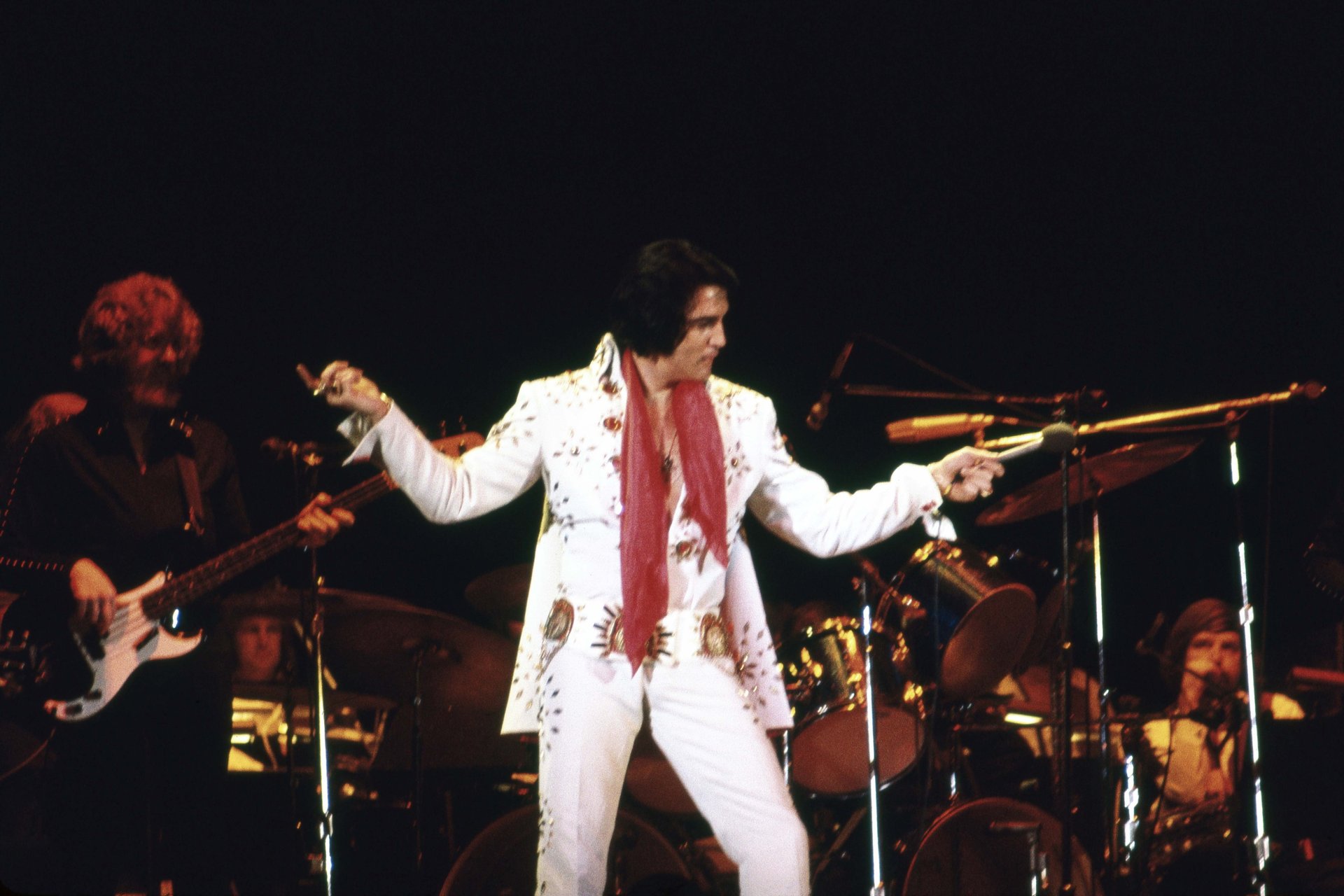
And how could this new, deluxe two CD collection not be great? Elvis' return to a paying audience in the summer of 1969 is now the stuff of rock 'n' roll legend. He trained for the event like a prizefighter, assembled a crack band led by Louisiana guitar slinger James Burton, moved like a man possessed and sang like he was going to blow out the doors of the International Hotel showroom. "Punk rock lounge music," recalled bass player Jerry Scheff. Hot damn right!
Originally issued by RCA in October 1969, Elvis In Person appeared just a few months following the completion of Presley's month-long attack on Las Vegas. The dozen songs made up one half of a curious hybrid live-studio release RCA called From Memphis to Vegas/From Vegas to Memphis. The other album, Back In Memphis, was comprised of additional superb material from his early 1969 sessions at American Sound studios. It was Elvis' first double album!
It was also the first of many live releases to follow, except that 1969 is marked by an unmatched intensity. CD 1 chronicles the album release, and includes bonus tracks. It's a great collection, showing how Elvis covered musical ground from as far back as 1955 and "Mystery Train," to his brand-new 1969 single, an astonishing eight-minute workout of "Suspicious Minds." A stunning live version of the Chuck Berry classic, "Johnny B. Goode," a tale as much Elvis' story as the songwriter's, was as delightful as it was unexpected. Another thrill the album delivered was Elvis running down Little Walter's #1 R&B hit, "My Babe." Choosing this Willie Dixon-penned classic proved that the hard edge of the Presley personality had not died in Hollywood.
When RCA soon compiled a live disc from the second Las Vegas stand, On Stage, February 1970, they lacked enough unique material. Thus, they needed to (quietly) use a couple of unissued recordings from 1969, a great version of Del Shannon's "Runaway," and "Yesterday," an earnest Beatles cover. No other songs would be mined in Elvis' lifetime from this landmark engagement.
Following a few nondescript tracks on 1980's Elvis Aron Presley box set, RCA's Collector's Gold popped up in 1991. At last fans got an entire disc of new live material from 1969, including several uncommon songs. Producer Ernst Jorgensen rounds out CD 1 of the 2009 FTD set with the 1970 album additions and the five exceptional tracks from Collector's Gold, "This Is The Story," "Inherit The Wind," "Rubberneckin'," "Reconsider Baby" and "Funny How Time Slips Away."
They all sound wonderful, having been remixed for the FTD release. In fact, the gentleness Elvis gives "Funny How Time Slips Away" in 1969 will be lost in later versions, in much the same way "Reconsider Baby" morphs from the strict blues of the original 1960 arrangement into a more contemporary, rock-blues style in the 1970s. They certainly rank among the finest live cuts of his later career.
CD 2 presents another complete 1969 show from RCA's multi-track archives, the August 22, 1969 DS, and it is off-the-charts magnificent. How lucky are fans to have received five, count 'em, five complete multi-track shows (Aug 21 DS - Aug 22 MS - Aug 23 MS - Aug 24 DS - Aug 26 MS) from this period? Elvis is less restrained than earlier in the month, but not nearly as goofy as he became before the month was complete. And the sound image on both discs of FTD's Elvis In Person mirrors that of the original 1969 album, a very classy touch.
Rolling through another incredible performance on CD 2, it's clear that all of the August 1969 recordings reflect, for lack of a better phrase, the sheer virility of the Presley presentation. Elvis sounds fully in command, from the most serious moment in a ballad like "Are You Lonesome To-night?" to the silliest aside in the middle of his nine-minute "Life Story" monologue. It is palpable, and draws a listener towards the artist in a manner that is almost obscene. This is what a caged tiger sounds like.
There was also a great deal of truth in Elvis' presentation, from the afore-mentioned monologue to the many risqué jokes he makes throughout the night. Elvis was both angry and ashamed at how his career had progressed. He took a lot of crap when he started out, and in so many words, we hear how much it hurt. It's a fascinating window into the true feelings of a man who usually kept to himself in public situations.
"Welcome to the big, freaky International Hotel," Elvis jokes after "All Shook Up." He explains the extra battery of microphones shortly after. "They're making a live album, so that's why these things look weird. So if you hear yourself laughing on record later on, you'll know, 'That's me, that's me, hot damn!'"
An extended introduction to his #1 single, "Hound Dog," typically running over two minutes this engagement, elicits a memory of being censored on a Florida tour in the summer of 1956. "Somebody told me to clean this act up one time, boy, I tell you (laughs)."
Elvis' live revival was not without some flaws. The staggering Mac Davis ballad from his 1968 TV Special, "Memories," sported a too-fast arrangement. Elvis rushes through the verses and chorus like he's late for a funeral! No wonder Sam Phillips expressed his disapproval when he heard it. Ironically, Elvis says hello mid-song to Jim and Gladys Tipler, who hired Elvis in April 1954 to drive a truck for Crown Electric, 353 Poplar Avenue in Memphis. Gladys lets him know it's her birthday too!
Many revelations came on a nightly basis with the mid-set "Life Story" monologue. Elvis sat on a stool, occasionally strumming his 1964 Gretsch Country Gentleman, and gave a potted history of his career. "My side of the story," he told the audience. Elvis was funny, even a touch profane, but he was also quietly revealing. It was a display he did not continue into the new decade.
"I was driving a truck, and I was studying to be an electrician. And the people I work for are here tonight. And, uh, they're really wonderful people. I'd just like you to say hello to Mr. and Mrs. Tipler. It's her birthday. Hello! Happy birthday," he proclaims.
The racial confusion which met the July 1954 release of "That's All Right" on SUN 209 is alluded to by the singer. "It became pretty big overnight in my hometown. You know, people were saying 'Who is he? What is he? Is he? Is he?' and I'm saying 'Am I? Am I?'" And the outrage Elvis caused on TV in 1956 is also touched upon, quite candidly. "So, uh, I went on the Jackie Gleason show first … at that time there was a lot of controversy about it. You didn't see people moving, out in public, you know. They were getting it on the back room, but you didn't see it too much in public ..."
In 1958, when the U.S. Army claimed the singer, it turned his world upside down. Elvis hid his despair then, but a decade later, it surfaces. "And then, I got drafted, and shafted, and everything else. Uh, so, overnight, it was all gone, and all this changed, it was like a dream, you know? I thought, 'Did that happen? Did that happen?' You know, no Cadillacs, no nothing, all shot." Thankfully, he didn't address the death of his beloved mom, although "all gone" could well imply her loss as well.
The remainder of the evening is mostly a rock 'n' roll sprint, from a full band rendition of Jimmy Reed's "Baby, What You Want Me To Do," James Burton's turnaround sounding like nothing but pure Robbie Robertson (The Band), to a touch of "Surrender" -- "I don’t want to do that song. I don’t know why I'm doing it, man," he quips -- before launching the band into another super version of "Runaway."
Elvis delivers beautiful interpretations of his newest singles, the top 3 hit "In The Ghetto," followed by a soon-to-be #1 smash. "Ah, a new song that I just recently recorded, it should be out in a week or two, I hope you like it, it's called 'Suspicious Minds.'" It's called fantastic, to say the least.
Presley closes with a whirlwind take on Ray Charles' "What'd I Say." It includes Charles' second verse, a nice surprise, and another wild, extended James Burton solo. His breathless "encore" is, of course, "Can't Help Falling In Love," one of his supreme ballads. The arrangement is monstrous compared to the 1961 single, but, hey, it's Las Vegas. "You're a beautiful audience, thank you very much," he says, and not for the last time.
As usual, the deluxe FTD package design is lovely. With a fold-out cover and a lengthy color booklet, it's a joy. Of course, in 1969 Elvis was "thin as a rake and handsomer than ten movie stars," so nearly every photo is amazing. Did any man ever look better? In addition, there are a number of interesting documents reproduced inside, along with a rundown of set lists from several rehearsals held at RCA Hollywood that July. They are a heart-stopping experience for a hardcore fan.
If July 1969 recordings exist of items like "I'll Hold You In My Heart," "Return To Sender," "Let Yourself Go," "If I Can Dream," "Slow Down," or especially "Seventeen" (AKA the Beatles classic, "I Saw Her Standing There"), let's pray we'll someday get to hear them.[Johnny Savage, USA]